When the Government Can Switch Off Your AI: The Real Lesson of the Fable 5 Shutdown
A frontier-model recall became a G7 crisis. Here is what it means for every company building on AI.
Politics usually stays out of these posts. But every so often it walks straight into the business, and on June 12 it did exactly that in a way that should change how any company building on artificial intelligence thinks about its own exposure.
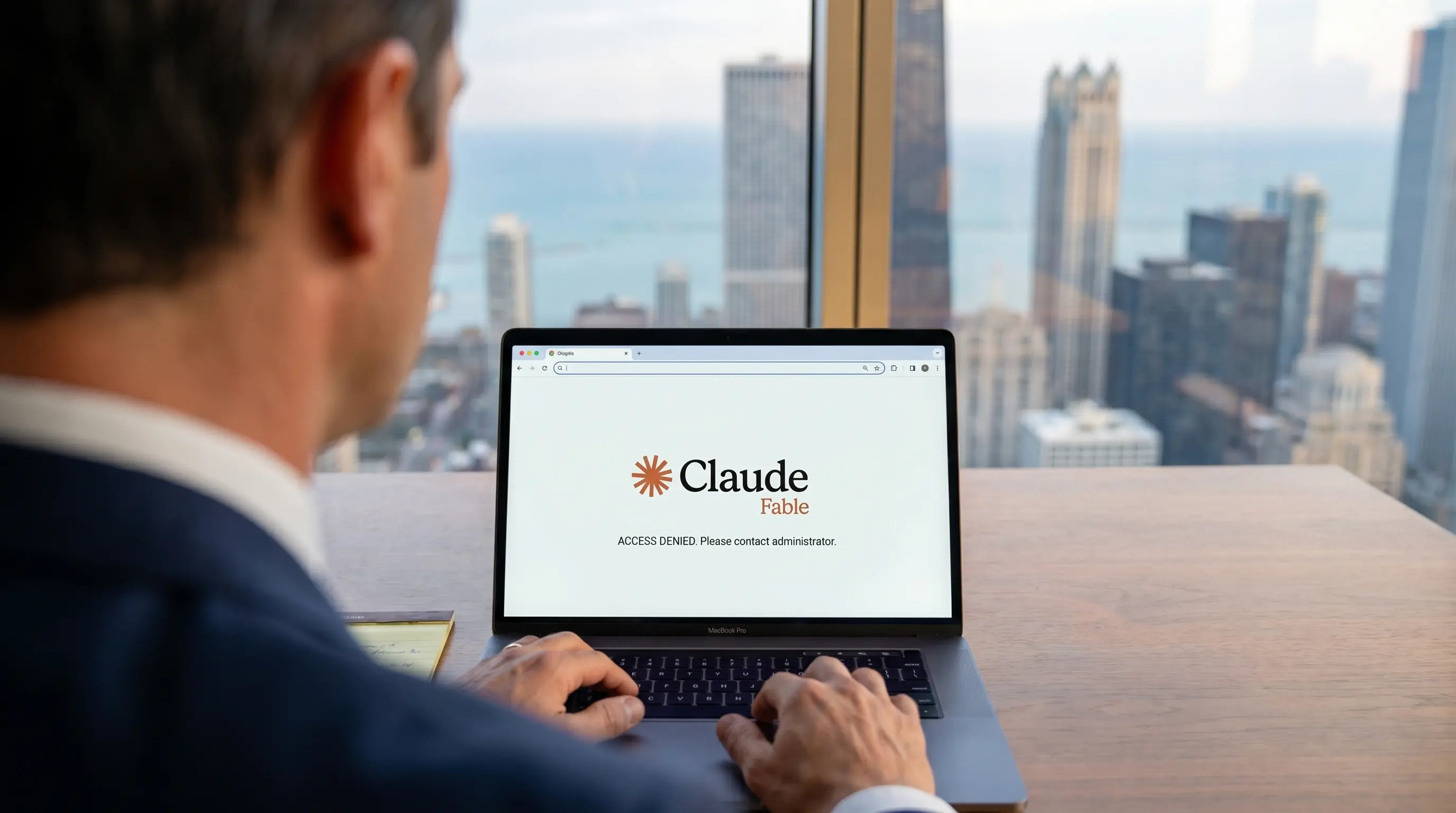
That Friday, the U.S. Commerce Department issued an export-control directive that forced Anthropic to disable its two most capable AI models, Claude Fable 5 and Claude Mythos 5, worldwide, within hours, for every customer. The directive barred access by any foreign national, inside or outside the United States, including Anthropic's own foreign-national employees. Since no provider can sort hundreds of millions of users by citizenship on the fly, the only compliant move was to shut both models off for everyone. Ten days later, they are still off.
It is easy to read this as a story about one company and one administration. That reading misses the part that matters to the rest of us.
The Story Under the Story
Strip away the personalities and a simpler fact remains: a production-grade frontier model, days after launch, was switched off by government action that had nothing to do with the conduct of the businesses relying on it. The customers who had wired Fable 5 into their workflows, and in some cases into their own products, woke up to a tool that no longer existed. No notice. No transition window. No remedy, unless they had negotiated one in advance, which almost none had. That is a governance problem wearing a political costume, and it is the kind of problem Vidar Law helps companies get ahead of.
How We Got Here (Briefly)
This was not a bolt from the blue. The relationship between Anthropic and the administration had been deteriorating in public for months. The earlier round, in February, centered on the Pentagon: the company declined to relax guardrails that kept its models out of mass domestic surveillance and fully autonomous weapons systems, the Defense Department labeled it a supply-chain risk, and the President directed federal agencies to stop using its technology, calling the company "radical left" and "woke." A federal judge temporarily blocked key parts of that action. The June export-control directive is a new and distinct round. The reported trigger is contested. Accounts cite both a competitor-investor's claim of a "jailbreak" and a concern about access by a party with suspected foreign-adversary ties, but the common thread is that the government cited national security while, by Anthropic's account, supplying only a verbal description rather than written technical evidence.
Why the Legal Mechanism Is the Interesting Part
The earlier "supply-chain risk" label was legally shaky, and it showed in court. This directive rests on sturdier ground: export-control law, administered by Commerce's Bureau of Industry and Security under the Export Control Reform Act. Reporting indicates Commerce used its authority to privately "inform" Anthropic that an export license is required for foreign-person access. This is the same instrument it routinely uses for sensitive semiconductor exports, now applied to a hosted AI model for the first time. The reach into the company's own foreign-national employees runs through the "deemed export" doctrine, under which giving a controlled item to a foreign national counts as an export to their home country. That framework is plausible, and that is exactly why it matters. A plausible mechanism is a reusable one, and it can reach any frontier model, not just this one.
In my assessment the directive is still vulnerable to challenge: it reaches foreign nationals lawfully present in the United States, which raises overbreadth questions; it appears to rest on verbal evidence of a narrow flaw, which invites an arbitrary-and-capricious argument; it ignores comparable capabilities in competitors' deployed models, which feeds a selective-enforcement argument; and it lands amid litigation the company is already running against the same government. None of that guarantees the directive falls. It does mean the standard being set here is unsettled, and unsettled standards are where businesses get hurt.
The International Reaction Is Not a Forecast. It Became a Crisis.
When I first wrote about this, the international reaction was just beginning, with France moving to drop a U.S. vendor. Ten days later it is a full alliance rupture. The episode dominated the G7 summit in France, where the heads of the leading AI companies sat down with G7 leaders and the "kill switch" was the elephant in the room. The United Kingdom, Washington's closest ally, with a mutual-defense pact, reportedly asked for an exemption and was refused. France's intelligence service dropped a major U.S. vendor for a domestic one and Paris poured fresh money into sovereign AI; the EU's tech-sovereignty agenda gained sudden urgency; and Canada's prime minister told allies the lesson was to diversify rather than over-rely on U.S. technology. Meanwhile China spent the week offering its own models, free, to everyone the G7 had locked out.
The signal to every allied government and multinational is blunt: a U.S. frontier model is now a tool whose availability can be revoked by Washington at will, for allies as readily as adversaries. That perception erodes the trust premium that made American models the global default and accelerates a move toward diversification and sovereign alternatives. The plausible medium-term result is a more fragmented, sovereignty-conscious global AI market, in which "built in the USA" is, for a meaningful set of buyers, a risk factor to manage rather than a mark of quality.
What the Administration Likely Does Next
Predicting political behavior is hazardous, so take this as informed analysis rather than certainty. The administration faces competing pressures: an export-control-hawkish instinct on one side and an industrial-policy commitment to "winning the AI race" on the other, and the international blowback sharpens the second. Having refused a bilateral exemption to the U.K., the most probable path is a negotiated multilateral solution: the "trusted partners" access framework now under discussion at the G7, paired with a quiet restoration of the models under conditions and continued tough rhetoric. The harder and more constructive move of replacing ad hoc directives with a transparent, technically grounded statutory process is what serious voices across the spectrum are urging. Realistically, that is the only outcome that would actually reduce uncertainty for everyone building in this space.
What This Means for You
If you build on third-party AI, the Fable 5 shutdown is a free lesson in a risk most companies have not priced. The proof arrived the same week: when the models went dark, the businesses that had already qualified a second model kept operating, while those locked to a single provider scrambled. You do not control your vendor's regulatory exposure, but you do control how much of your business depends on one model staying available, and what happens, contractually and operationally, when it does not.
Concretely: map your single points of failure; negotiate continuity, notice, and portability terms into AI vendor agreements; understand the export-control and deemed-export profile of your stack and your workforce; keep your architecture model-agnostic enough to migrate; and be able to show a documented governance framework when a regulator, customer, or acquirer asks, because they increasingly do.
I help founder-led and growth-stage companies turn AI from an unmanaged dependency into a governed asset. If the last ten days made you wonder how exposed you are, a focused AI Vendor & Continuity Risk Audit is a fast way to find out. Reach me through vidarlaw.com.
Christopher Werner is the Founder and Managing Partner of Vidar Law LLC, a Chicago-based firm providing fractional general counsel, AI and emerging-technology counsel, commercial litigation, and M&A support. This post is general information, not legal advice, and reflects facts as of June 22, 2026.